Doesn't that sound good?
This continues my series of recipes from my most recent cooking class at the Institute of Culinary Education, Vive la Bretagne. If you're looking for a refined appetizer or even a small meal for your next dinner, this is a winner. As if smoked salmon wasn't delicious enough--here, the salmon is stuffed with an herbed whipped cream made from crème fraiche, and garnished with marinated fennel and shallot confit.
Not too shabby on the whole.
The Recipe:
6 slices of smoked salmon
3 regular-sized fennel bulbs
8 ounces lemon juice
6 tbsps extra-virgin olive oil
4 shallots
1/2 cup dry red wine
1 cup ruby Port
1 thyme sprig
1 tsp sugar
1 quart crème fraiche
Chives
1 tsp cider vinegar
Salt and Cayenne pepper to taste
First, wash and clean the fennel. Chop off the leaves just up to the bulb and remove the roots. Using a mandolin or a sharp knife, slice the fennel bulbs very thinly (width-wise) so that you have thin slices. Layer the fennel slices along the bottom of a 9"x13" pan. Stir the lemon juice and olive oil together and pour over the fennel in the pan. Season with salt and cayenne pepper. Cover and refrigerate for 2 hours, to marinate.
To make the shallot confit, preheat your oven to 350 degrees. Combine the Port, wine, thyme, sugar, and shallots--cut in 1/4" thick slices--in a small gratin dish. Cover with foil and bake for an hour, then remove foil and bake for another 15 minutes or until the liquid has almost evaporated. Let cool to room temperature, and discard the thyme sprig.
Now, for the pièce de resistance--the salmon with cream. Whisk the crème fraiche as you would whisk whipping cream, until it forms soft peaks. Then add the salt, cayenne pepper, chives, vinegar, and half of the shallot confit.
Now for the tricky part: presentation. This is my way of plating the dish, but don't hesitate to be creative with your presentation. To fill the salmon slices with the cream, take a paper cup and cut off the topmost ring to use as a mold. Place the ring on the plate and drape salmon slices over the edges, so that they touch the plate but will be able to be folded over. Then, put the cream in the center of the ring of salmon, and fold the pieces over. Remove the ring. Place a few slices of the marinated fennel on the side, and garnish with additional shallot confit. Garnish with thyme sprigs and lemon rind curls.
Showing posts with label cooking classes. Show all posts
Tuesday, January 24, 2012
Wednesday, January 18, 2012
Salade de Roscoff: Salad of Warm, Seasonal Vegetables
As I had mentioned in my previous post, I attended my second class at the Institute of Culinary Education. The class, entitled "Vive la Bretagne: Brittany's Signature Dishes" gave a soup to nuts--or in this case, fish to flan--overview of the fresh and crisp cooking of France's northwestern peninsula.
The first dish from the series was a Salade de Roscoff, or a salad of warm, seasonal vegetables in a vinaigrette. This salad features leeks, turnips, fennel, carrots, onions, and potatoes at their very best: intact, colorful, and filled with flavor and nutrients. This dish celebrates each vegetable in its natural form, preserving the shape and manipulating it minimally.
Baby fennel: First, wash your fennel and pat dry. Then cut off the majority of the fluffy green stalk, leaving 2 or 3 springs for garnish. Halve the fennel lengthwise, and carefully remove their root bulbs.
Baby leeks: Baby leeks are leeks, but smaller (as in they look like scallions). You will not need to rinse them, as you would with typical leeks, as they will not have much sand in them. Rather, carefully cut off the roots, and then peel off the outermost layer of skin, pulling the green leaf and removing the exterior of the leek. Cut off the dark green stems and rinse the leeks.
Baby turnips: Cut off the stems and the roots and rinse. Using the sharp edge of your knife, delicately peel the turnips so that you remove only a thin layer of skin.
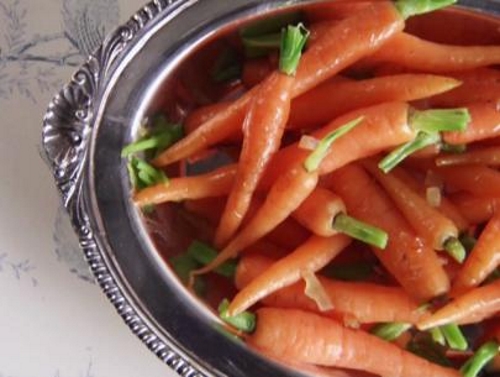
Baby carrots: Cut off the stems, and peel carefully, as you peeled the turnips (with the edge of a knife).
Fingerling potatoes: Rinse the skin. Do not peel the skin off, as it is filled with nutrients. Just halve them lengthwise.
Now that you have prepared all of your vegetables, it is time to blanch them in the chicken stock. Blanching is when you place vegetables in boiling water (or, in this case, stock), remove them after a short time, and then plunge them into ice water. The ice water halts the cooking process and ensures that vegetables are colorful and retain their nutrients and flavor. Prepare an ice bath, and then blanch each vegetable.
While they are sitting in the ice bath, make your vinaigrette:
Dice the shallots and chives. In a small bowl, whisk together the oil and vinegar, and then slowly incorporate the mustard, chives, shallots, are garlic, whisking well.
To finish off, toss the warm vegetables in the vinaigrette and serve on a warmed plate.
The first dish from the series was a Salade de Roscoff, or a salad of warm, seasonal vegetables in a vinaigrette. This salad features leeks, turnips, fennel, carrots, onions, and potatoes at their very best: intact, colorful, and filled with flavor and nutrients. This dish celebrates each vegetable in its natural form, preserving the shape and manipulating it minimally.
The Recipe:
12 baby carrots
12 pearl onions
6 baby fennel
2 leeks (young, if possible)
12 baby turnips
12 fingerling potatoes
3 quarts chicken stock
For the vinaigrette:
1 shallot
Chives (to taste)
1 garlic clove
2 tbsps cider vinegar
1 tbsp dijon mustard
3 tbsps extra virgin olive oil
First, you will need to clean and peel all of your vegetables. Before you reach for that peeler (I see you--STOP), put it back and get a small, sharp knife. As I mentioned above, this dish celebrates vegetables in their natural and unaltered state (with a little sauce). Since most of the vegetables we are using are small, baby vegetables, they are delicate and we must treat them as such.
Here are instructions for peeling and preparing each vegetable in the salad:
Baby carrots: Cut off the stems, and peel carefully, as you peeled the turnips (with the edge of a knife).
Fingerling potatoes: Rinse the skin. Do not peel the skin off, as it is filled with nutrients. Just halve them lengthwise.
Now that you have prepared all of your vegetables, it is time to blanch them in the chicken stock. Blanching is when you place vegetables in boiling water (or, in this case, stock), remove them after a short time, and then plunge them into ice water. The ice water halts the cooking process and ensures that vegetables are colorful and retain their nutrients and flavor. Prepare an ice bath, and then blanch each vegetable.
While they are sitting in the ice bath, make your vinaigrette:
Dice the shallots and chives. In a small bowl, whisk together the oil and vinegar, and then slowly incorporate the mustard, chives, shallots, are garlic, whisking well.
To finish off, toss the warm vegetables in the vinaigrette and serve on a warmed plate.
Tuesday, January 17, 2012
Vive la Bretagne : ICE Revisited
As some of you may remember, I had the pleasure of taking my very first cooking class this past Fall. Ever since attending "Elegant Autumn Desserts" with Chef Vicki Wells at the Institute for Culinary Education in downtown Manhattan, I'd been aching to go back and try my hand on some other delicacies.
The Institute for Culinary Education is located on 23rd street between 5th and 6th avenue, and offers a full range of recreational cooking classes for those interested in cooking, baking, wine and bar-tending, and cheese.
This time around, I chose Vive la Bretagne, a celebration of tradition Bréton cuisine. The class was taught by Chef Hervé Riou who is an ambassador of Breton cuisine in the United States, representing the Union Culinaire Bretonne. My motivations for taking this particular class were twofold: first, my family originates from Brittany, the northwestern peninsula of France that projects into the Atlantic Ocean, and, second, I was looking to acquire some tricksy cooking skills.
The class was limited to 20 people and was spread over four hours on a Monday morning. The price was reasonable, considering the time in the kitchen, the price of the materials, and the fact that you got to take bags of goodies home. (I have what must amount to three rabbits in my fridge.)
Within our four hours we made Salade de Roscoff (salad of warm seasonal vegetables in an herb vinaigrette), Timbale de saumon aux herbes et fenouil marinée (smoked salmon served with marinated fennel in lemon and creme fouette with shallots confit), Soupe de poisson cotriade (traditional fish soup), Medaillons de veau à la mode d'Iffiniac (sautéed veal medaillons with Muscadet, onion and grated cheese), Coquille St Jacques à la Concarnoise (pan-seared scallops served with a ragout of chanterelles or wild mushrooms and a vermouth reduction), Lapin sauté aux herbes de Bretagnes (rabbit braised with mushroom shallots parsley and a white wine-herb infusion), Flan de St Enogat (flan with marc of cider and apples or pears caramalized), and Traou Mad (traditional butter cake).
Each one was relatively simple to make, and came out looking and tasting divine. Each used tools and ingredients that are easily available and that shouldn't be too much of a drain on the budget.
This time around--motivated by the gift of two cooking classes of my choice for Christmas--I decided to opt for a cooking class as opposed to a baking class. People always ask me what I prefer--cooking or baking. I'd have to say that I prefer baking, because it just comes to me more naturally. There seems to me that there is less room for error, and who could say no to working with ingredients like cream, chocolate, and sugar? I do enjoy cooking though, even though it does not come as easily to me.
This time around, I chose Vive la Bretagne, a celebration of tradition Bréton cuisine. The class was taught by Chef Hervé Riou who is an ambassador of Breton cuisine in the United States, representing the Union Culinaire Bretonne. My motivations for taking this particular class were twofold: first, my family originates from Brittany, the northwestern peninsula of France that projects into the Atlantic Ocean, and, second, I was looking to acquire some tricksy cooking skills.
The class was limited to 20 people and was spread over four hours on a Monday morning. The price was reasonable, considering the time in the kitchen, the price of the materials, and the fact that you got to take bags of goodies home. (I have what must amount to three rabbits in my fridge.)
Within our four hours we made Salade de Roscoff (salad of warm seasonal vegetables in an herb vinaigrette), Timbale de saumon aux herbes et fenouil marinée (smoked salmon served with marinated fennel in lemon and creme fouette with shallots confit), Soupe de poisson cotriade (traditional fish soup), Medaillons de veau à la mode d'Iffiniac (sautéed veal medaillons with Muscadet, onion and grated cheese), Coquille St Jacques à la Concarnoise (pan-seared scallops served with a ragout of chanterelles or wild mushrooms and a vermouth reduction), Lapin sauté aux herbes de Bretagnes (rabbit braised with mushroom shallots parsley and a white wine-herb infusion), Flan de St Enogat (flan with marc of cider and apples or pears caramalized), and Traou Mad (traditional butter cake).
Each one was relatively simple to make, and came out looking and tasting divine. Each used tools and ingredients that are easily available and that shouldn't be too much of a drain on the budget.
Look for each recipe as I remake them in the confines of my home kitchen in the next few weeks!
Friday, October 14, 2011
Elegant Autumn Desserts : Spicy Maple and Pumpkin Flan

For those of you who did not read my post from this past weekend, I had the real treat of taking a cooking class at the Institute of Culinary Education in the Flatiron District of Manhattan. The class, entitled Elegant Autumn Desserts and taught by executive pastry chef, Vicki Wells, covered many sophisticated autumn desserts that look fantastic but are relatively simple to make.
As promised, I am re-making each of the desserts from the class at home to (a) see if they work in a non-magical cooking class setting, (b) eat them again, and (c) share them with you.
The first of these desserts in this series is the Spicy Maple and Pumpkin Flan, which was probably my favorite.
This flan is not difficult or time consuming, but does take a few tricks to make it work. The result is an incredibly smooth and subtle maple and pumpkin flavor that is to die for.
The Recipe
For the flan molds:
1 cup sugar
1 tsp heavy cream
1 tbsp butter
2 tsps rum
First, set up about 8 small ramekins in a deep baking pan so that they are ready when you pour in the caramel.
You will now need to caramelize the sugar. This can be a tricky task, especially if you have not made caramel before. I will give you one warning I wish I had had when I first made caramel last year: DO NOT TOUCH IT. EVER.* Put your sugar in a saucepan and add just enough water to moisten it. This will not be much. You do not want to bathe the sugar, just to make it damp. Then put it on the stove over medium heat and let it warm. You will not want to stir it with a spoon because the sugar will solidify. Just make sure to swirl the pan often, to move the mixture around. The mixture will soon start to develop big bubbles and will then very suddenly start to turn color. While the sugar is cooking, prepare your cream, butter, and rum and have them on standby. As soon as the sugar turns a caramel brown, remove it from heat and add the other ingredients. Swirl and let it combine. Then, pour a small amount into the ramekins (about 1/2") and let them cool and set.
For the flan:
1-1/2 cups heavy cream
1/2 cup milk
5 egg yolks
5 tbsps sugar
1-1/2 ounces maple syrup
3-1/2 ounces canned pumpkin
1/8 tsp Green Mountain maple extract (available at Fairway!)
1/4 tsp ground cloves
1/4 tsp ground ginger
1/4 tsp cinnamon
Preheat oven to 300' F.
Dry roast the spices in a medium saucepan. You will just need to heat them for a few seconds, until they release an intense aroma. As soon as this happens, add the cream and milk and whisk. Add half the sugar and bring to a boil, whisking. Then remove from heat and let cool 10 minutes.
Meanwhile, combine the yolks very well with a whisk. Add the other half of the sugar, the maple syrup, and the maple extract.
Temper the cream to the yolk mixture. Pour in a little of the cream and whisk well before adding another small amount. Do this until it is all combined. Add the pumpkin and stir very well, until smooth. Strain and remove the foam.
Pour into the caramel filled molds. Now, create a water bath with boiling water. The water should go 1/3 of the way up the ramekin sides. Bake them until they are set and no longer jiggle. Let them in room temperature and transfer to the fridge when cooled slightly.
When ready to serve, turn the ramekin over a plate and tap to release the flan.
*Sugar's boiling point is much higher than water, so not only is it scalding, but it will also solidify, while still scalding you, which makes it impossible to get off before severe damage is done. I was dumb. Learn from me.
Sunday, October 9, 2011
Elegant Autumn Desserts at the Institute for Culinary Education
Yesterday morning, I had the pleasure of attending my first class at the Institute for Culinary Education, located on 23rd street between 5th and 6th avenue. As I had been getting more interested in baking and cooking, and as I had been devoting more time to it recently, I became interested in finding recreational cooking or baking classes in the city that would (a) get me out of the house, (b) let me meet new people, and (c) let me learn some very valuable kitchen skills.
But where was I going to find these cooking classes that I had in mind? I Googled it.
The Institute for Culinary Education offers a full range of recreational cooking classes for those interested in cooking, baking, wine and bar-tending, and cheese.
The class that caught my eye was "Elegant Autumn Desserts" taught by chef Vicki Wells, the Executive Pastry Chef at Buddakan who has worked with Sarabeth’s Kitchen, Hotel Plaza Athenée, Maxim’s, Montrachet, Rakel’s, Metro, El Dorado Petit, Le Bernardin and Trattoria Dell’Arte.
The class was limited to 10 people and was spread over four hours on a Saturday morning. The price was reasonable, considering the time in the kitchen, the price of the materials, and the fact that you got to take bags of goodies home.
Within our four hours we made a Warm Apple Cider Cake with Bourbon Vanilla Ice Cream, Spicy Maple Pumpkin Flan with Gingersnaps, Pears Poached in Pinot Noir, Double Chocolate Shortcakes with Oven-Roasted Cranberries, and a Warm Greenmarket Apple Charlotte with Clove Molasses Ice Cream.
Each one was relatively simple to make, and came out looking and tasting divine. Each used tools and ingredients that are easily available and that shouldn't be too much of a drain on the budget.
The Cider Cake was built on a great basic recipe that takes a normal spice cake and adds onto it with variations of the liquid used. While we used bourbon, you can substitute any alcohol or even coffee as the liquid. The cake was filled with a tangy cider reduction and topped with bourbon vanilla ice cream, which was so good that I might invest in an ice cream machine.

The Pumpkin Flan might have been my favorite of all the desserts. It incorporated the welcome fall flavors of maple syrup and pumpkin into a smooth flan topped with a caramel layer and sauce. The flan was served with a dollop of fresh whipped cream and a gingersnap as garnish.

The Chocolate Shortbread tasted very similar to a chocolate mousse that Alex makes. It took a chocolate shortbread biscuit which was then topped with cranberries and chocolate pastry cream. This was another dessert that I could never tire of eating.

The Apple Charlotte was a variation on a French apple upside-down tart, which was made with a brioche crust and filled with caramelized apples and apple compote. A perfect version of an apple tart for fall.

I will undoubtedly be attempting these recipes again over the next few weeks, and with each attempt, I will post the recipe for the desserts I have described above. So, stay tuned, and get hungry!
Also make sure to check out ICE's list of classes at : http://rec.iceculinary.com/
But where was I going to find these cooking classes that I had in mind? I Googled it.
The Institute for Culinary Education offers a full range of recreational cooking classes for those interested in cooking, baking, wine and bar-tending, and cheese.
The class that caught my eye was "Elegant Autumn Desserts" taught by chef Vicki Wells, the Executive Pastry Chef at Buddakan who has worked with Sarabeth’s Kitchen, Hotel Plaza Athenée, Maxim’s, Montrachet, Rakel’s, Metro, El Dorado Petit, Le Bernardin and Trattoria Dell’Arte.
The class was limited to 10 people and was spread over four hours on a Saturday morning. The price was reasonable, considering the time in the kitchen, the price of the materials, and the fact that you got to take bags of goodies home.
Within our four hours we made a Warm Apple Cider Cake with Bourbon Vanilla Ice Cream, Spicy Maple Pumpkin Flan with Gingersnaps, Pears Poached in Pinot Noir, Double Chocolate Shortcakes with Oven-Roasted Cranberries, and a Warm Greenmarket Apple Charlotte with Clove Molasses Ice Cream.
Each one was relatively simple to make, and came out looking and tasting divine. Each used tools and ingredients that are easily available and that shouldn't be too much of a drain on the budget.
The Cider Cake was built on a great basic recipe that takes a normal spice cake and adds onto it with variations of the liquid used. While we used bourbon, you can substitute any alcohol or even coffee as the liquid. The cake was filled with a tangy cider reduction and topped with bourbon vanilla ice cream, which was so good that I might invest in an ice cream machine.

The Pumpkin Flan might have been my favorite of all the desserts. It incorporated the welcome fall flavors of maple syrup and pumpkin into a smooth flan topped with a caramel layer and sauce. The flan was served with a dollop of fresh whipped cream and a gingersnap as garnish.

The Chocolate Shortbread tasted very similar to a chocolate mousse that Alex makes. It took a chocolate shortbread biscuit which was then topped with cranberries and chocolate pastry cream. This was another dessert that I could never tire of eating.

The Apple Charlotte was a variation on a French apple upside-down tart, which was made with a brioche crust and filled with caramelized apples and apple compote. A perfect version of an apple tart for fall.

I will undoubtedly be attempting these recipes again over the next few weeks, and with each attempt, I will post the recipe for the desserts I have described above. So, stay tuned, and get hungry!
Also make sure to check out ICE's list of classes at : http://rec.iceculinary.com/
Subscribe to:
Posts (Atom)