Showing posts with label leek. Show all posts

Wednesday, January 18, 2012

Salade de Roscoff: Salad of Warm, Seasonal Vegetables

As I had mentioned in my previous post, I attended my second class at the Institute of Culinary Education. The class, entitled "Vive la Bretagne: Brittany's Signature Dishes" gave a soup to nuts--or in this case, fish to flan--overview of the fresh and crisp cooking of France's northwestern peninsula.

The first dish from the series was a Salade de Roscoff, or a salad of warm, seasonal vegetables in a vinaigrette. This salad features leeks, turnips, fennel, carrots, onions, and potatoes at their very best: intact, colorful, and filled with flavor and nutrients. This dish celebrates each vegetable in its natural form, preserving the shape and manipulating it minimally.


The Recipe:

12 baby carrots
12 pearl onions
6 baby fennel
2 leeks (young, if possible)
12 baby turnips
12 fingerling potatoes
3 quarts chicken stock

For the vinaigrette:

1 shallot
Chives (to taste)
1 garlic clove
2 tbsps cider vinegar
1 tbsp dijon mustard
3 tbsps extra virgin olive oil

First, you will need to clean and peel all of your vegetables. Before you reach for that peeler (I see you--STOP), put it back and get a small, sharp knife. As I mentioned above, this dish celebrates vegetables in their natural and unaltered state (with a little sauce). Since most of the vegetables we are using are small, baby vegetables, they are delicate and we must treat them as such. 

Here are instructions for peeling and preparing each vegetable in the salad:

Baby fennel: First, wash your fennel and pat dry. Then cut off the majority of the fluffy green stalk, leaving 2 or 3 springs for garnish. Halve the fennel lengthwise, and carefully remove their root bulbs. 
Baby leeks: Baby leeks are leeks, but smaller (as in they look like scallions). You will not need to rinse them, as you would with typical leeks, as they will not have much sand in them. Rather, carefully cut off the roots, and then peel off the outermost layer of skin, pulling the green leaf and removing the exterior of the leek. Cut off the dark green stems and rinse the leeks.

Baby turnips: Cut off the stems and the roots and rinse. Using the sharp edge of your knife, delicately peel the turnips so that you remove only a thin layer of skin.
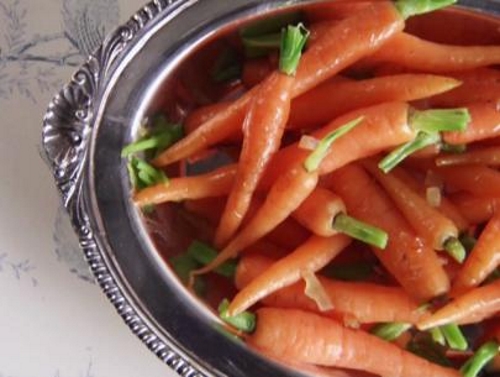
Baby carrots: Cut off the stems, and peel carefully, as you peeled the turnips (with the edge of a knife).

Fingerling potatoes: Rinse the skin. Do not peel the skin off, as it is filled with nutrients. Just halve them lengthwise.


Now that you have prepared all of your vegetables, it is time to blanch them in the chicken stock. Blanching is when you place vegetables in boiling water (or, in this case, stock), remove them after a short time, and then plunge them into ice water. The ice water halts the cooking process and ensures that vegetables are colorful and retain their nutrients and flavor. Prepare an ice bath, and then blanch each vegetable.

While they are sitting in the ice bath, make your vinaigrette:

Dice the shallots and chives. In a small bowl, whisk together the oil and vinegar, and then slowly incorporate the mustard, chives, shallots, are garlic, whisking well.

To finish off, toss the warm vegetables in the vinaigrette and serve on a warmed plate.

Tuesday, January 17, 2012

Vive la Bretagne : ICE Revisited

As some of you may remember, I had the pleasure of taking my very first cooking class this past Fall. Ever since attending "Elegant Autumn Desserts" with Chef Vicki Wells at the Institute for Culinary Education in downtown Manhattan, I'd been aching to go back and try my hand on some other delicacies.

The Institute for Culinary Education is located on 23rd street between 5th and 6th avenue, and offers a full range of recreational cooking classes for those interested in cooking, baking, wine and bar-tending, and cheese.

This time around--motivated by the gift of two cooking classes of my choice for Christmas--I decided to opt for a cooking class as opposed to a baking class. People always ask me what I prefer--cooking or baking. I'd have to say that I prefer baking, because it just comes to me more naturally. There seems to me that there is less room for error, and who could say no to working with ingredients like cream, chocolate, and sugar? I do enjoy cooking though, even though it does not come as easily to me.

This time around, I chose Vive la Bretagne, a celebration of tradition Bréton cuisine. The class was taught by Chef Hervé Riou who is an ambassador of Breton cuisine in the United States, representing the Union Culinaire Bretonne. My motivations for taking this particular class were twofold: first, my family originates from Brittany, the northwestern peninsula of France that projects into the Atlantic Ocean, and, second, I was looking to acquire some tricksy cooking skills.

The class was limited to 20 people and was spread over four hours on a Monday morning. The price was reasonable, considering the time in the kitchen, the price of the materials, and the fact that you got to take bags of goodies home. (I have what must amount to three rabbits in my fridge.)

Within our four hours we made Salade de Roscoff (salad of warm seasonal vegetables in an herb vinaigrette), Timbale de saumon aux herbes et fenouil marinée (smoked salmon served with marinated fennel in lemon and creme fouette with shallots confit), Soupe de poisson cotriade (traditional fish soup), Medaillons de veau à la mode d'Iffiniac (sautéed veal medaillons with Muscadet, onion and grated cheese), Coquille St Jacques à la Concarnoise (pan-seared scallops served with a ragout of chanterelles or wild mushrooms and a vermouth reduction), Lapin sauté aux herbes de Bretagnes (rabbit braised with mushroom shallots parsley and a white wine-herb infusion), Flan de St Enogat (flan with marc of cider and apples or pears caramalized), and Traou Mad (traditional butter cake).

Each one was relatively simple to make, and came out looking and tasting divine. Each used tools and ingredients that are easily available and that shouldn't be too much of a drain on the budget.

Look for each recipe as I remake them in the confines of my home kitchen in the next few weeks!

Wednesday, October 26, 2011

Potato and Leek Soup

I went to the Farmers' Market this weekend to take advantage of the last fresh produce of the year and picked up some lovely leeks. My dad suggested that I make leek and potato soup.

I was looking for a simple recipe, with a lot of flavor, that I could make quickly and found one that fit the bill: it uses relatively few ingredients, doesn't take much time, and requires no complex kitchen skills. So, chop those vegetables, peel some potatoes, and prepare for a warm and comforting dinner.

The Recipe:

2 tablespoons butter
2 large leeks (see my note below on how to clean leeks)
2 russet potatoes, peeled and cut into small chunks
1 quart low-sodium chicken stock
1/2 cup heavy cream
Salt and freshly ground black pepper
1 tsp thyme
Chopped fresh chives, for garnish

First prepare the leeks: Feel the outside skin of the leek and cut off the leaves where they start to feel tough. If the portion attached to the white part feels tough cut it until you have the white part and a bit of the light green part left. Cut off the roots and cut the leek lengthwise. Then slice into thin slices. Rinsing leeks is important, but is also a pain. Put your leek slices in a collander, and rinse them thoroughly to get the dirt and sand out from between the thin layers.

In a large saucepan over medium-high heat, melt the butter and saute the leeks until soft, about 3 to 5 minutes. Add the potatoes and stock and cook until the vegetables are cooked through and beginning to fall apart, about 15 to 20 minutes. Using a blender, ladle the soup into the blender and blend until smooth but with some small chunks remaining. You may have to do this in 2 batches. Add the cream and blend to combine, then check for seasoning and add salt and pepper, to taste. Serve hot ladled into soup bowls and topped with some of the chopped chives.

Monday, September 26, 2011

Scandanavian Smoked Fish Quiche


With a removable-bottom quiche pan comes great enthusiasm.

Last Monday, my mom and I made a pilgrimage to Bed, Bath, and Beyond to purchase some additions to our meager collection of cooking supplies at home. Two hours and a great deal of excitement later, we came home with 3 non-slip mixing bowls, a block of knives, and a removable-bottom quiche pan.

Over the summer, I had spent a great deal of time in Boston where Alex was living and working for the summer. On the days when I was there and he had to work, I amused myself by exploring the Boston and Cambridge areas. One of my favourite places to visit was a shop in Harvard Square (also with a location on Beacon Street) called Black Ink. The shop is a treasure trove for all kinds of kooky, fun, clever, and generally unnecessary things that you just have to have. The two things that I purchased there over the summer were both unnecessary, but at least practical--a Not for Tourists Guide to New York City, and a Nordic Bakery Cookbook filled with scrumptious recipes for novel foods. A book with a passage that reads, "This recipe is traditionally made with reindeer meat, but as reindeer meat is not widely available, we have replaced it with bacon" (LMAO).

There are at least six recipes in the book that required this fabled quiche pan, and I wanted to make them. All of them.

The first one I am attempting is a Smoked Fish Tart with leeks and cheese.


The Recipe:

13 tbsps unsalted butter

3 1/2 tbsps sour cream

1 cup flour (the recipe calls for all-purpose, but I made it with whole wheat)

1 tsp baking powder

pinch of salt

***

1 tbsp canola oil

2 leeks, trimmed, cleaned, and thinly sliced

3 eggs

2/3 cup milk

1 cup grated sharp cheddar cheese

small handfull of dill

7 oz smoked / cooked fish of any kind (I used cod)

sea salt and pepper

***
For the crust:

Cream the butter and sour cream in a mixing bowl. In another bowl, combine the dry ingredients. Add to the butter mixture and mix until a dough forms. Roll the dough into a ball, and then flatten into a disk. Wrap with plastic wrap and refrigerate for at least 2 hours (overnight is better!).

For the quiche:

Preheat your oven to 400 degrees. If you are using fresh fish instead of smoked, cook it at 450 degrees (8 minutes per 1/2 inch of thickness).

Start to prepare the filling. Heat a skillet with the oil and add your leeks. Cook them on medium-low for about five minutes or until they become slightly soft.

If you are a first-time-leek-cooker like me, here is how to prepare a leek:

Feel the outside skin of the leek and cut off the leaves where they start to feel tough. If the portion attached to the white part feels tough cut it until you have the white part and a bit of the light green part left. Cut off the roots and cut the leek lengthwise. Then slice into thin slices. Rinsing leeks is important, but is also a pain. Put your leek slices in a collander, and rinse them thoroughly to get the dirt and sand out from between the thin layers.

While your leeks are cooking, prepare the other filling. Combine the eggs, milk, dill, and cheese and stir well. Season with salt and pepper.

Here comes the slightly tricky part: you will need to roll out the dough and then place it into the tart pan. My dough was very hard to handle because it became soft very quickly after being taken out of the fridge, which made it impossible to roll and move. Take the dough out of the fridge and roll it immediately even if it seems stiff. If you worry about making it into the pan, take the removable bottom of the pan and roll on top of it, before popping it into the rim of the pan. Do this step quickly to avoid a mess / having to re-chill the dough.

Once it is in the pan, press it to the sides and bottom and remove excess dough from the top.

Put the leeks in the crust, as well as the fish. Then pour in the wet mixture. Make sure everything is evenly distributed.

Place in the oven (preferably on a cookie sheet to avoid mess) and cook for 25-30 minutes, or until the pastry is brown.

Serve wam or cold.

***

Check out Black Ink at their website: http://blackinkboston.squarespace.com/

Buy the book at Amazon: http://www.amazon.com/Nordic-Bakery-Cookbook-Miisa-Mink/dp/1849750963/ref=sr_1_1?s=books&ie=UTF8&qid=1316533222&sr=1-1